
Practical Lessons on Why Values Matter
At Your Health, we recently introduced our Purpose, Vision, and Values. Not as words to display, but as a commitment to how we show up for each other, and more importantly, for our patients.
As we continue building a stronger culture and more connected community of healthcare professionals at Your Health, we asked ourselves an important question:
Who is doing this at the highest level, and what can we learn from them?
That led us to Tripp J. Welch, leader of Professionalism and Values at Mayo Clinic—one of the most respected healthcare institutions in the world, and one of the first group medical practices ever established. With over 85,000 staff and a deeply rooted patient-first philosophy, Mayo Clinic’s approach to values is not aspirational.
It is a lived model.
The Story That Stopped the Room
A story from Tripp’s time conducting qualitative research around employee engagement, where he was studying what truly drives teamwork inside Mayo Clinic. During that work, he met a nurse in the ICU named Dan. On Dan’s computer was a screensaver: a quiet sunset over the Mississippi River. Tripp assumed it was a personal photo—a cabin, a favorite place.
So Tripp asked about it.
Dan then spoke about a woman who approached him. Her father was dying. And she said something that would define everything that followed:
“I don’t want him to die in the hospital. Can you help me get him home?”
That request wasn’t simple. Discharging a patient from the ICU, especially under those circumstances, is complex. It requires coordination across multiple teams, systems, and timelines. But Dan didn’t hesitate.
He made the calls. He coordinated with pharmacy. He worked with hospice. He aligned care teams. And by that afternoon, the patient was home. Two weeks later, the woman returned. She handed Dan a photograph.

And she told him: “This is the last sunset my father saw, from his bedroom, surrounded by family, overlooking the dock where he taught his grandkids to fish.” Then she said something he would never forget: “I want you to understand the impact you had.”
Tripp shared that up until that moment, he had always thought of hope and miracles as cures.
But that experience changed everything.
It redefined:
what compassion really means
what it means to serve
and how often we never fully understand the impact of our actions
If she hadn’t come back, Dan may have never known. And yet, the impact was undeniable.
The Conversation It Sparked Amongst Our Team
Following the story, our team paused and reflected and shared stories together during the Colleague Connection, because at its heart it is about building closer bonds as well so we can better coordinate care as a team. Because this wasn’t just a story about Mayo Clinic. It was a story about what’s possible.
One truth became clear: Communication is how values are expressed.
Not in theory. But in moments. There are moments in healthcare that never make it into a report.
What Mayo Clinic Does Differently
Tripp shared several insights into how Mayo Clinic ensures their values are not just stated, but lived.
Employee Onboarding is not about the paperwork, it’s about alignment
From the very first day, everyone, from physicians to support staff, comes together around one shared understanding: We all serve the patient. From the janitor to doctor, no one is above any one else, we connect and the values take center stage.
Hiring for Values, Not Just Skill
Mayo’s hiring process is intentionally slow. By the time someone is interviewed, their skills are already there.
The real question is: Can they embody the values and our patient-first foundation?
From the very beginning, Mayo Clinic has operated with a clear philosophy:
“The best interest of the patient is the only interest to be considered.”
— Dr. William J. Mayo
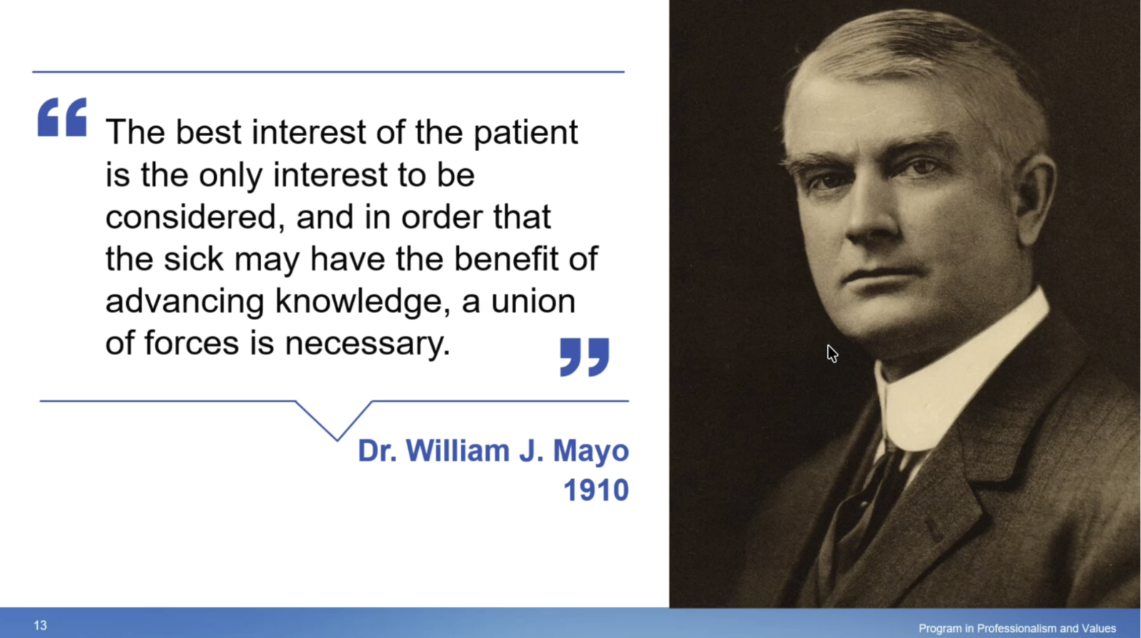
This is not a statement on a wall. It is how decisions are made.
Values Are Not spoken about once, it’s revisited Annually in Employee Reviews.
Performance is not measured by outcomes alone. It is measured by how those outcomes are demonstrated throughout the year. Each individual is assessed on two simple standards when considering the values in reviews. Did this employee demonstrate each of our values successfully? Either did they achieve them, or do they need further development?
Behavior Is Addressed Early, A Values Conversation.
When values are not being demonstrated, Mayo does not default immediately to HR. The goal is not punishment. Because once people stop feeling safe to communicate, the system breaks. They engage in direct, private conversations. It’s about alignment.
Leadership Evolves
Mayo’s rotational leadership model requires leaders to shift roles every 5–7 years.
Why? As Tripp shared:
“After five to seven years, it becomes harder to see the same opportunities. Fresh eyes see what others no longer can.”
That way leadership can get fresh perspective and relationships can drive better outcomes and no one becomes stagnant.
What This Means for Your Health
Beyond simply understanding our Purpose, Vision, and Values, our ongoing discussion should focus on how to effectively translate these principles, alongside insights from Mayo Clinic, into the core operations of our organization. The goal is to positively influence patient outcomes by improving how we interact and collaborate to best serve our patients. We must live our values at every level.
A special thanks to Tripp J. Welch for sharing his time, his experience, and a story that will stay with us. And thank you to all who participated in the conversation—sharing reflections, experiences, and a shared commitment to doing better for each other and for our patients.